
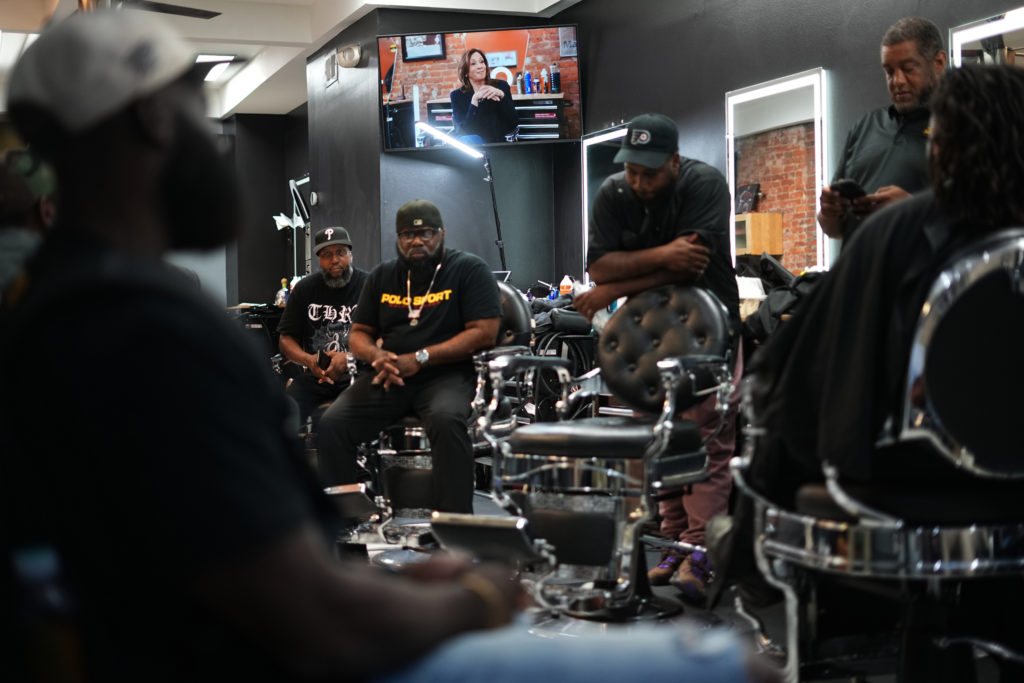
Inside a crowded West Philadelphia barbershop, the usual hum of clippers and scent of hair products recently blended with a spirited debate over power, identity, and betrayal. Political strategist Khalil Thompson brought his organization, Win With Black Men, to Philly Cuts to tackle a question that has haunted Democratic strategists since Kamala Harris lost the presidency: why did some Black men drift toward Donald Trump? In a city where Black residents make up forty percent of the population, these conversations aren’t just social gatherings; they are essential intelligence for a party that knows its path to victory in Pennsylvania depends on mobilizing this specific demographic.
The atmosphere grew electric as the discussion shifted from general community needs to the polarizing figure of Donald Trump. Stanley Thigpen, a civil engineer, sparked a raucous exchange by suggesting that Trump had long been a fixture in Black culture, citing rappers who referenced him. He was quickly met with groans and sharp rebuttals from others, like real estate agent Al Glay, who reminded the room of Trump’s history of racial rhetoric regarding the Central Park Five. The tension peaked when Glay asked how anyone could look at Kamala Harris—the first Black woman nominated for president by a major party—and choose a white man instead.
Beyond the partisan fighting, there was a deep sense of exhaustion present among the men gathered around the barber chairs. Maurice Anderson, one of the shop’s barbers, spoke candidly about a generational distrust of government that transcends party lines. He pointed to historical wounds, such as Bill Clinton’s crime legislation that fueled mass incarceration, arguing that many Black men feel simply tapped out by promises that never materialize into tangible change. This feeling of abandonment creates a vacuum where traditional political loyalty fades and skepticism becomes the default setting.
Despite the friction, Thompson believes the solution lies in abandoning the idea that Black men are a monolith. From those working in car plants in Detroit to those attending rodeos in Texas, he argues that messaging must reflect diverse economic realities rather than relying on filtered tropes. As State Senator Vincent Hughes noted following the event, the goal is to transform this raw anger into actionable political power. For now, however, the barbershop remains one of the few places where these contradictions can be aired openly over plates of cheesesteaks and fresh haircuts.